Turkish draughts rules
Turkish draughts - Dama - is played on all 64 squares of an 8×8 board with sixteen men a side, and no piece ever moves diagonally. If you know checkers, almost every instinct you have transfers wrongly, which is most of the appeal.
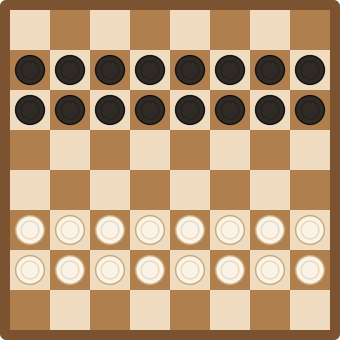
The board and the men
Every square is in play, light and dark alike. Each player sets up sixteen men in two full rows - the second and third rows from their own side - leaving their back row empty. That empty row is not decoration: it is the row an enemy man has to reach to be crowned, and it is where your own kings will end up defending.
How men move
A man moves one square straight forward or one square sideways, never diagonally and never backwards. Sideways movement means a Turkish man can sidestep a blockade instead of being stuck behind it.
Capturing, and the maximum
A man captures by jumping an adjacent enemy piece - forwards or sideways, never backwards - and landing on the empty square directly beyond. Capturing is compulsory, and when several captures are available you must play one that takes the most pieces.
Captured pieces are removed from the board the instant they are jumped, not at the end of the sequence. That single difference changes what is possible: the square a captured piece stood on becomes free immediately, so a chain can double back through it. In the diagonal rule sets, captured pieces stay standing until the move is over and block their own removal route.
A capture chain continues as long as the piece that just landed can jump again, and the whole chain is one move.
Kings
A man that ends its move on the opposite back row becomes a king. A man that only passes through it in the middle of a capture is not crowned; it finishes the chain as a man.
A king moves any distance along a rank or a file, like a rook, and captures the same way: it may stand well back, jump a single enemy piece with empty squares between them, and land on any free square beyond it. It may turn a corner and keep capturing - but it may not turn straight back the way it came within the same chain.
Winning and drawing
You win by taking every enemy piece or by leaving your opponent without a legal move.
The game is drawn on the third occurrence of the same position with the same player to move, or after 100 plies without progress. Progress here means a capture, a promotion, or a man changing rank - and note that a sideways step is not progress, because it can be taken straight back. Two men shuffling left and right forever would otherwise never end the game, and that is exactly the case the rule closes.
| Board | 8×8, all 64 squares in play |
|---|---|
| Pieces | 16 men per side, two rows, back row empty |
| First move | Light |
| Man moves | One square forward or sideways |
| Man captures | Forward or sideways, never backwards |
| King | Any distance along a rank or file |
| Capture | Compulsory, maximum capture compulsory |
| Captured pieces | Removed immediately, mid-chain |
| King in a chain | May turn, may not reverse |
| Draw | Threefold repetition, or 100 plies without progress |
Play it
Kondavo runs Turkish draughts as its own rule set with its own rating and its own computer opponent - not the checkers engine with the diagonals swapped out.
Play Turkish draughtsIt opens in the browser - no download, and no account before the first move.