Checkers rules
English checkers - also called American checkers or English draughts - is the 8×8 game with twelve men a side, forward-only movement and a king that steps one square. These are its rules in full.
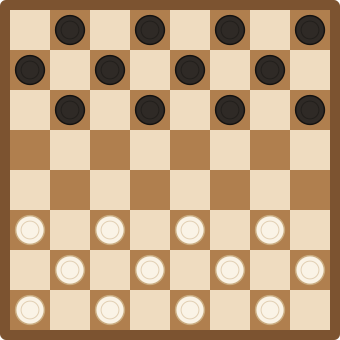
The board and the men
The board is 8×8 and only the dark squares are ever used, so the whole game happens on 32 squares. Each player starts with twelve men filling the three rows nearest them. Dark moves first, and the players alternate.
How the pieces move
A man moves one square diagonally forward, onto an empty square. Forward means away from its own side; a man may never move backwards. Nothing may be jumped over during an ordinary move, and no square may hold two pieces.
Capturing is compulsory
If any capture is available to you, you must capture - an ordinary move is not legal while a jump exists. You jump an enemy piece by leaping over it diagonally forward and landing on the empty square directly beyond it, and the jumped piece is removed.
If the piece that just landed can jump again, it must, and the whole chain counts as one move. Choosing between jumps is free: English checkers has no maximum-capture rule, so you may take a single piece even when a three-piece chain is available on the other side of the board. That single difference is what makes it a different game from international draughts, where the longest capture is compulsory.
A man captures forwards only. A king captures in all four diagonal directions.
Kings
A man that ends its move on the far row is crowned and becomes a king. Promotion ends the turn - this matters when it happens in the middle of a capture chain: a man that lands on the back row by jumping stops there, even if the new king could carry on jumping. It resumes as a king on your next turn.
A king moves and captures one square diagonally in any of the four directions, forwards or backwards. It does not slide the length of a diagonal; that is the "flying king" of the international, Spanish, Brazilian and Turkish rules, and it is not part of this game.
Winning, and the draw rule
You win when your opponent has no pieces left, or when they have pieces but no legal move - a player who is completely blocked has lost, and blocking is a legitimate way to win rather than a stalemate.
A game is drawn when the same position occurs for the third time with the same player to move, or when 100 plies (50 moves by each player) pass without progress. Progress means a capture, a promotion, or a man advancing a rank; a man can never move backwards, so pushing one is irreversible. Kings shuffling back and forth are not progress, which is exactly the position the rule exists to end.
| Board | 8×8, dark squares only |
|---|---|
| Pieces | 12 men per side, three rows |
| First move | Dark |
| Man moves | One square diagonally forward |
| Man captures | Forward only |
| King | One square, any diagonal direction |
| Capture | Compulsory; any available capture may be chosen |
| Promotion | Ends the turn, including mid-capture |
| Draw | Threefold repetition, or 100 plies without progress |
Play it
Kondavo implements these rules exactly - including the parts people argue about, like the man that stops on promotion. Play a rated game online, or the computer with no connection at all.
Play checkersIt opens in the browser - no download, and no account before the first move.