International draughts rules
International draughts - Polish draughts, the 100-square game - is played on a 10×10 board with twenty men a side. Men capture backwards, kings fly the length of a diagonal, and you are always obliged to take the most pieces available.
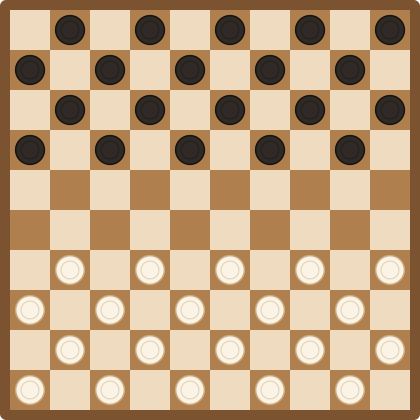
The board and the men
Ten rows of ten, fifty dark squares in play, four rows of men each - twenty pieces a side. The board is turned so that each player has a dark square in the left-hand corner nearest them. Light moves first.
How men move
A man moves one square diagonally forward onto an empty square, and cannot move backwards. That restriction applies to moving only; capturing is another matter entirely.
Capturing: backwards, and the longest line
A man captures by jumping an adjacent enemy piece and landing on the empty square immediately beyond it - forwards or backwards, on any of the four diagonals. If the piece can jump again from where it lands, it must, and the whole chain is one move.
Capturing is compulsory, and so is taking the maximum: when several capture sequences are available you must play one that takes the greatest number of pieces. A two-piece jump is illegal while a five-piece jump exists anywhere on the board, no matter how much you would prefer the two. This is the rule that gives the 10×10 game its character - long forced combinations where a sacrifice drags an opponent's piece onto the square that makes the whole chain work.
Captured pieces stay on the board until the sequence is complete, and no piece may be jumped twice in the same move. Because they are still standing, a piece already jumped also blocks a later leap in the same chain - a detail that turns some tempting-looking combinations into illegal moves.
Kings fly
A man that ends its move on the far row is promoted to king. A man that merely passes over the far row during a capture and jumps onward is not promoted - it finishes the chain as a man and stays one. Promotion happens only when the move ends there.
A king moves any distance along a free diagonal, in any of the four directions. It captures at a distance too: it may sit several squares away from an enemy piece, jump it, and land on any free square beyond it, choosing where to stop - and that choice usually decides whether the chain continues.
Winning and drawing
You win when your opponent has no pieces or no legal move. Shutting in the last mobile piece is a win, not a stalemate.
The game is drawn on the third occurrence of the same position with the same player to move, or after 120 plies - 60 moves each - without progress. Progress means a capture, a promotion, or a man advancing a rank. Two kings circling each other are not progress.
| Board | 10×10, dark squares only |
|---|---|
| Pieces | 20 men per side, four rows |
| First move | Light |
| Man moves | One square diagonally forward |
| Man captures | All four diagonal directions |
| King | Flying: any distance along a diagonal |
| Capture | Compulsory, and the maximum capture is compulsory |
| Promotion | Only when the move ends on the far row |
| Draw | Threefold repetition, or 120 plies without progress |
The same rules on a smaller board
Brazilian draughts is this rule set on an 8×8 board with twelve men a side: capture in every direction, flying kings, maximum capture compulsory. The combinations arrive faster and the endgames are shorter. Kondavo has both, and rates them separately.
Play it
Play international draughtsIt opens in the browser - no download, and no account before the first move.